
It’s Germany, Stupid: Deutsche bank (NYSE: DB)
Image Courtesy of Niklas Jeromin, via Pexels
Our Latest PodCast: the Euro’s quiet rise makes for a profoundly unlikely banking success
Earlier this month, the International Monetary Fund quietly released its quarterly Currency Composition of Official Foreign Exchange Reserve report for the first 3 months of 2026. This so-called COFER data summed up the foreign currency walking-around money central banks must keep on hand, to balance payments with economies besides their own.
Why it seems to matter: The Q1 2026 report, pictured below, confirmed a modest — but significant — increase in global central-bank exposure to euros, starting about a year ago.
Why it really matters: Late last year, in another report, the IMF attempted to pass off the world’s new interest in the Eurozone currency as a natural outcome of the quirks of foreign exchange.
The IMF pointed out that all currencies are valued in U.S. dollars.
Therefore, a central bank’s Euros can change in value even though those Euros are not bought or sold.
However, as pictured below, the IMF makes it clear not all of that new value can be explained by currency effects. Something else is driving investor interest in the Eurozone.
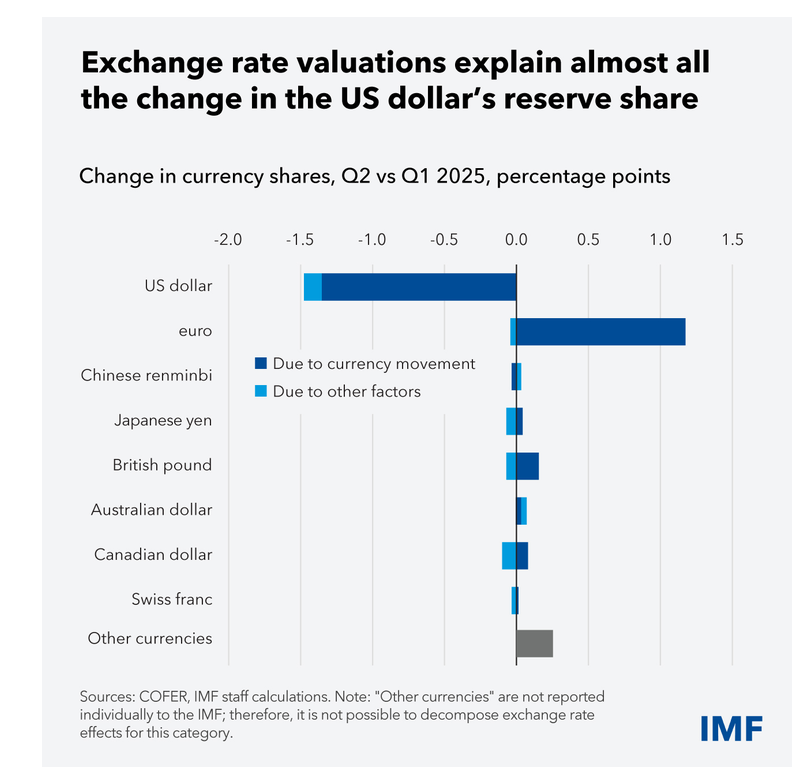
Exchange effects definitely played a roll in bullish value of foreign-held euros. But core demand for European currency also grew.
It’s A Mad, Mad, Mad World: What then, is driving central bank interest in the euro? That’s easy: Risk. Regional conflict, political rivalries, and uncertain supply and costs have destabilized the world’s economies.
As stodgy as Europe might be, it’s relatively stable compared to other options.
Considering Germany is, by far, the Eurozone’s largest economy, any kind of fresh interest in the euro will flow value into German financial centers.
What value flows into Germany will almost certainly flow into Germany’s bank: Deutsche Bank.
Yeah, Deutsche Bank: We totally get it: Any economic narrative that leads to a troubled financial institution, like Deutsche Bank, has to be carefully vetted.
David Enrich’s book Dark Towers is the must-read on the bank’s questionable ethics from World War II to the 1990s New York real estate market.
Deutsche Bank also played a central role in leaked U.S. Treasury suspicious activity reports for the past several decades.
The bank probably played a major role in allegations of money laundering around the globe. Yes, the sitting American president is a major character.
Such global acting-out has suppressed enterprise value: The bank routinely trades at about half of most other banks, as pictured below.
But that ethics story may be slowly changing.
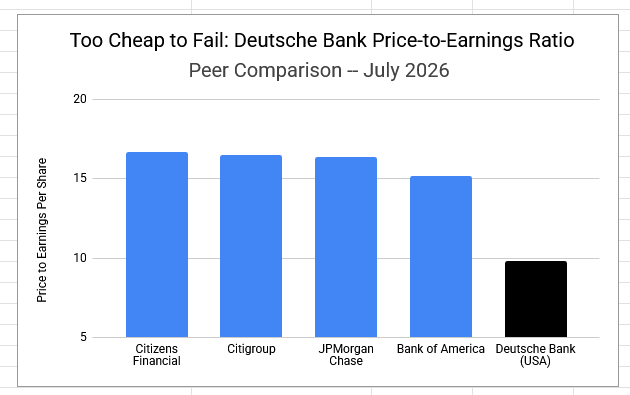
Deutsche Bank’s troubled past has caused investor jitters. The bank usually trades at about half of its peers. But that might just be a point of entry.
“Gute” Deutsche Bank: But yesterday is exactly that. Over the recent term, recently installed CEO, Christian Sewing has done a good job of refocusing the operation on core services and lending.
The bank reported record profits for 2025.
Return-on-tangible equity was north of 10% for the year.
The enterprise paid a decent dividend of about 1 euro per share.
That performance has piqued investor interest. Slowly! Buyers outpaced sellers for company stock for the past 18 months. But enterprise value has yet to push through its 52-week high, posted back in January 2026.
Deutsche Bank is not a zippy neobank unicorn, as say, Kazakhstan’s Kaspi Bank (KSPI).

Considering how risky the rest of the world has become, Deutsche Bank will benefit from the fresh investor interest in the Eurozone.
To Cheap to Fail: It’s this simple: Smart money is looking for save havens, these days. And the Eurozone is one of the world’s calm pools. Considering Deutsche Bank is as big a player in Europe as anybody or anything, it value must rise.
Considering how cheap it is, dare we use the world “bargain?” Why not?
And with that, “Guten tag, mein freund.”